Repeated data entry
Teams copy the same details between spreadsheets, messages and business tools.

CUSTOM SOFTWARE DEVELOPMENT / FROM WORKFLOW TO WORKING PRODUCT
Bring a business process into focus, define the right first release and build with a clear scope. For startups, MSMEs and growing enterprises ready to move beyond disconnected tools.
Discovery first · Reviewable milestones · Practical handover
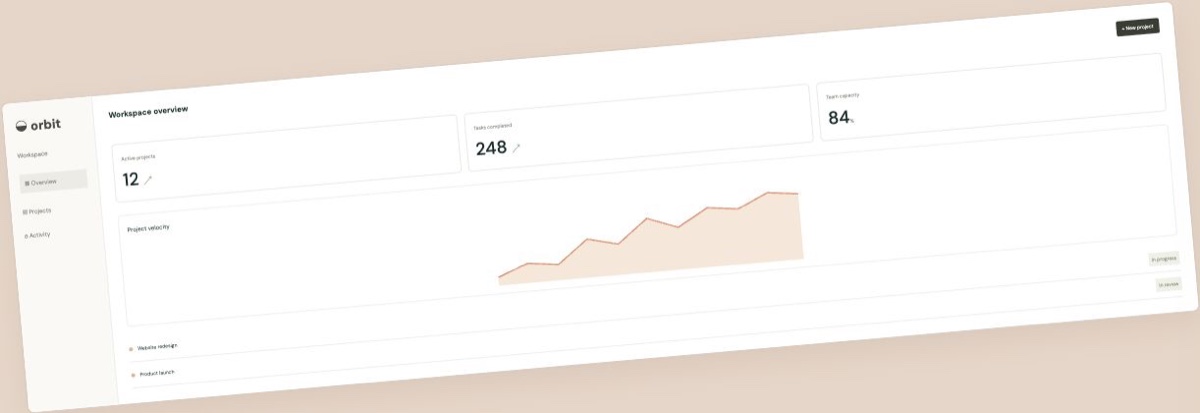
Illustrative interface, not a deployed client system or evidence of its proposed backend stack.
WHEN OFF-THE-SHELF TOOLS LEAVE GAPS
We start by understanding what is getting in the way—and whether custom software is the right response.
Teams copy the same details between spreadsheets, messages and business tools.
Requests move through people without a consistent status, owner or approval path.
Workarounds become routine, and useful changes are difficult to make safely.
SOFTWARE SOLUTIONS
These are solution areas for discovery and scoping. Delivery commitments depend on the requirements, available expertise and technical assessment.
Shape enquiry intake, customer records, sales stages and follow-up responsibilities around your actual sales process.
Map connected business processes and data ownership first. Scope modules, controls and migration in manageable phases rather than promising a complete ERP upfront.
Define the product’s first useful release, user roles and account model. Assess tenancy, subscriptions and operational requirements before implementation.
Bring agreed tasks, records, approvals and status updates into a coherent internal workflow.
Design role-appropriate views, useful filters and clear actions. Connect reporting to agreed, validated data sources.
Plan stock records, movements and reconciliation rules. Multi-location operations, scanning and existing-system sync need separate assessment.
Define availability, booking requests and cancellation rules. Calendar connections, live availability and payments depend on the systems involved.
Build scoped endpoints and server-side validation, with access controls, error handling and a documented integration contract.
Assess whether a responsive web experience or a dedicated app fits the job. Native platform delivery, devices and release expertise are confirmed before commitment.
Assess API availability, account access and data mapping before promising a connection. Include failure handling and ownership of ongoing maintenance.
INDUSTRY USE CASES
Illustrative scenarios for conversation—not claims of completed sector projects or measured client results.
Retail & distribution
A proposed workflow: record stock movements, review exceptions and route replenishment requests. Source systems, location rules and reconciliation must be agreed.
Professional services
A proposed workflow: capture an enquiry, assign an owner, approve the scope and track delivery tasks. Permissions and customer communication remain explicit.
Manufacturing
A proposed workflow: capture a production request, review requirements and track approval stages. Production planning and ERP integration require separate discovery.
Healthcare & appointments
A proposed workflow: collect appointment requests and route them for staff confirmation. Clinical decisions and sensitive-data access require appropriate qualified oversight.
Startups & product teams
A proposed workflow: define one core user journey, validate a prototype and release an agreed MVP. Broader functionality follows evidence and a separately prioritised roadmap.
Growing enterprises
A proposed workflow: link authorised records between two systems and surface failures for review. Existing APIs, security requirements and data ownership drive feasibility.
DEVELOPMENT METHODOLOGY
A proposed working model that makes assumptions, feedback and acceptance visible throughout the project.
Maintain an agreed backlog and separate essentials from later ideas.
Demonstrate progress and collect feedback at agreed milestones.
Agree observable acceptance criteria and checks for each scoped delivery.
Record decisions, assess changes and confirm their cost and schedule impact before proceeding.
TECHNOLOGY CAPABILITIES / EVIDENCE BEFORE CLAIMS
The evidence available here is this website’s source and deployment. Fictional portfolio concepts and a technology list are not proof of production client experience.
The current website uses reusable React interfaces, typed components and responsive CSS. This is inspectable project work, not a claim about an undisclosed client portfolio.
The current enquiry service validates requests, stores consented enquiries and handles errors. Authentication and more complex application APIs need their own design and implementation scope.
This website runs on a Linux server behind Nginx with a managed Node process. Multi-region infrastructure, autoscaling and cloud-provider specialisms are not established by this project.
This repository uses private file storage for enquiries; it does not establish production SQL/NoSQL delivery experience. Database selection and implementation capability are confirmed for your project.
A proposed connection depends on supported APIs, provider terms and authorised credentials. No specific CRM, ERP or payment connector is represented as already delivered here.
The website demonstrates responsive web interfaces, not a shipped native app or live AI integration. Relevant delivery experience and feasibility are reviewed before committing to either.
Project fit is confirmed before commitment. Ask us to review the relevant implementation evidence, responsibilities and proposed stack during discovery. Technologies beyond the demonstrated work are assessed rather than presented as established specialisms.
PROJECT LIFECYCLE
Each stage has a concrete output. Scope, acceptance and ownership stay visible as the project develops.
Map users, current tools, business rules, constraints and the outcome you want to improve.
Output: problem statement and initial scope.Agree data ownership, integration boundaries, roles, acceptance criteria and the first release.
Output: proposal, technical approach and delivery plan.Make core screens and journeys reviewable before building the full application.
Output: agreed flows and interface direction.Work through prioritised increments with demonstrations and checks matched to the agreed risks.
Output: reviewable implementation and acceptance evidence.Plan hosting, access, migration where needed, release checks and rollback responsibilities.
Output: approved release and operational handover.Review feedback and agree maintenance, monitoring and future changes as a separate ongoing scope.
Output: clear ownership and a prioritised next phase.ENGAGEMENT MODELS
Custom software is quoted after discovery. Scope, staffing availability, milestones and commercial terms are confirmed in writing.
For a startup or a new business workflow.
Define the core journey, technical feasibility and a bounded first release. Subsequent features are a separate phase.
Discuss the engagementFor an agreed system or operational improvement.
Use defined deliverables and acceptance milestones. New requirements follow an agreed change process.
Discuss the engagementFor an evolving roadmap after an initial release.
Agree priorities, capacity, review cadence and support responsibilities. Availability and coverage are confirmed before engagement.
Discuss the engagementImplementation, third-party licences, hosting, migration, specialist reviews, applicable taxes and ongoing support are itemised as relevant. No fixed price, team size or delivery date is implied before agreement.
BEFORE WE BUILD
We start by mapping the processes and modules you need. A focused first phase is often more practical than replacing every system at once. Final capability, scope, integrations and delivery commitments are confirmed after discovery.
The demonstrated technologies on this page come from this website’s repository and deployment. Your project’s stack is selected after reviewing requirements, operating costs, maintainability and available delivery expertise. We do not claim unverified database, native-app, AI or cloud-provider experience.
We review users, screens, workflows, data, integrations, access controls and acceptance criteria. The written proposal sets the scope, milestones, assumptions and commercial terms. Custom software does not inherit the website package prices.
We assess the code or integration documentation, licence conditions, APIs and authorised access first. We identify migration and maintenance risks before proposing changes. Compatibility cannot be promised before that review.
Ownership, licensing, third-party dependencies, repository access and account responsibilities are defined in the project agreement. Handover deliverables and any restrictions are agreed before implementation begins.
We agree access roles, validation, data handling and testing appropriate to the project. Sensitive actions and data need clear controls. Security reviews, specialist testing, backups and recovery expectations are scoped rather than implied as certifications or guarantees.
Yes. We can scope a first release around a core user journey and acceptance criteria. Later features are prioritised after feedback. An MVP is a deliberately bounded product phase, not a promise of every feature at a discounted fixed price.
Maintenance, response coverage, monitoring, updates and future development are optional and separately agreed. The proposal and handover distinguish your responsibilities, hosting-provider responsibilities and the studio’s contracted support.
LET’S UNDERSTAND THE WORK FIRST
Share the process, product idea or operational gap you want to improve. We’ll start with the requirements, technical fit and a practical next step.
Request a Free ConsultationFree initial conversation · No obligation · English & Hindi